Gibraltar today
A border territory that lives from both sides
Modern Gibraltar is a self-governing British Overseas Territory with a thriving tourism, finance and shipping economy.
Its population blends British, Genoese, Maltese, Spanish, Jewish and North African heritage.
Relations with Spain shape daily life, from the border to currency preferences.
Modern Gibraltar is a self-governing British Overseas Territory of a few square kilometres, with its own parliament, its own laws and its own currency, while defence and foreign affairs remain with the United Kingdom. Everything else — schools, health, planning, taxes — is decided locally.
What makes it unusual is not its size but its daily rhythm. Thousands of people cross the border each working day from La Línea and the surrounding Spanish towns, filling offices, shops, restaurants and building sites, then going home in the evening. Gibraltar's economy — tourism, financial and online services, shipping and bunkering at the port — depends on that flow as much as on the Rock itself.
The population is small and layered: British, Genoese, Maltese, Andalusian, Jewish, Indian and Moroccan families have been settling here for generations, which is why you hear English, Spanish and Llanito in the same conversation and see a synagogue, a mosque, a Catholic cathedral and an Anglican church within walking distance of each other.
- Explains why the border, not the Rock, sets the rhythm of a visit.
- Shows how a territory of a few square kilometres runs its own affairs.
- Makes sense of the mix of languages, religions and surnames you meet in one street.
- Connects the fortress history you visit with the working town you walk through.
- Main Street on a weekday morning: a working high street, not only a tourist strip.
- Casemates Square, where cross-border commuters, cruise visitors and locals share the same terraces.
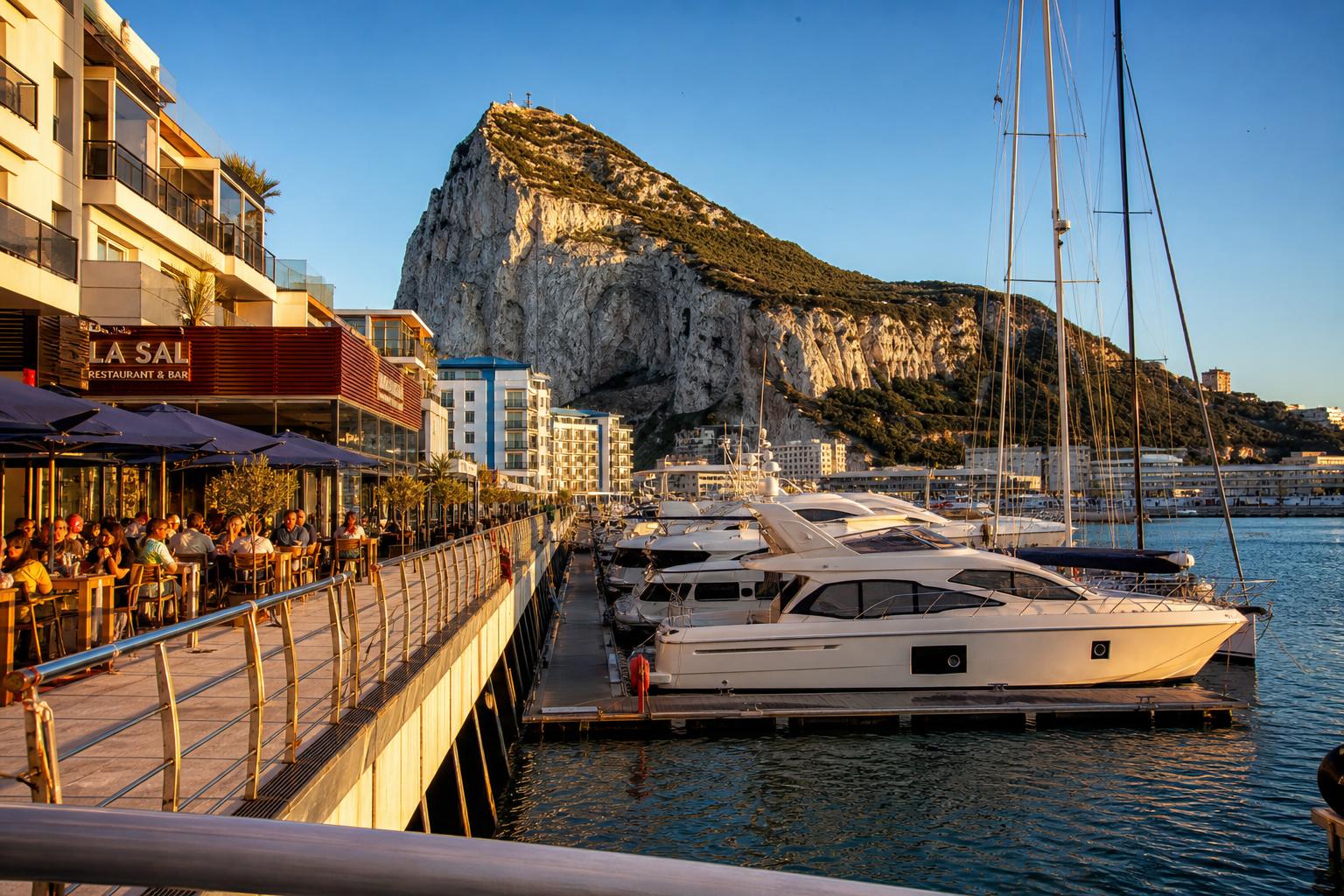
- Ocean Village and the marinas, the most visible face of the modern service economy.
- The port and the bay, with tankers waiting offshore for bunkering and supplies.
- Places of worship of four faiths within the small grid of the old town.
Reading Gibraltar as a British theme park with monkeys on top. It is a working territory whose daily life is shaped by the border queue, by cross-border employment and by a very mixed local society — ignore that and you only see the postcard.
Spend twenty minutes on Main Street and Casemates before or after the Rock, outside the cruise-ship rush, and just listen. The switching between English, Spanish and Llanito tells you more about today's Gibraltar than any viewpoint.
Continue exploring
Frequently asked questions
Is Gibraltar part of the United Kingdom?
No. It is a British Overseas Territory: self-governing in almost all internal matters, with the UK responsible for defence and foreign affairs.
Is Gibraltar part of Spain or the EU?
Neither. It is a separate jurisdiction with its own laws, its own customs regime and its own currency, which is why the crossing works like a real border.
What language do people speak today?
English is official and Spanish is everyday. Between locals you will often hear Llanito, the local mix of Andalusian Spanish and English.
What does Gibraltar live on?
Mainly tourism, financial and online services, port activity including ship bunkering, and cross-border trade and employment.
Do many people cross the border to work?
Yes. A large share of the workforce lives on the Spanish side and commutes daily, which is why queues peak at the start and end of the working day.